
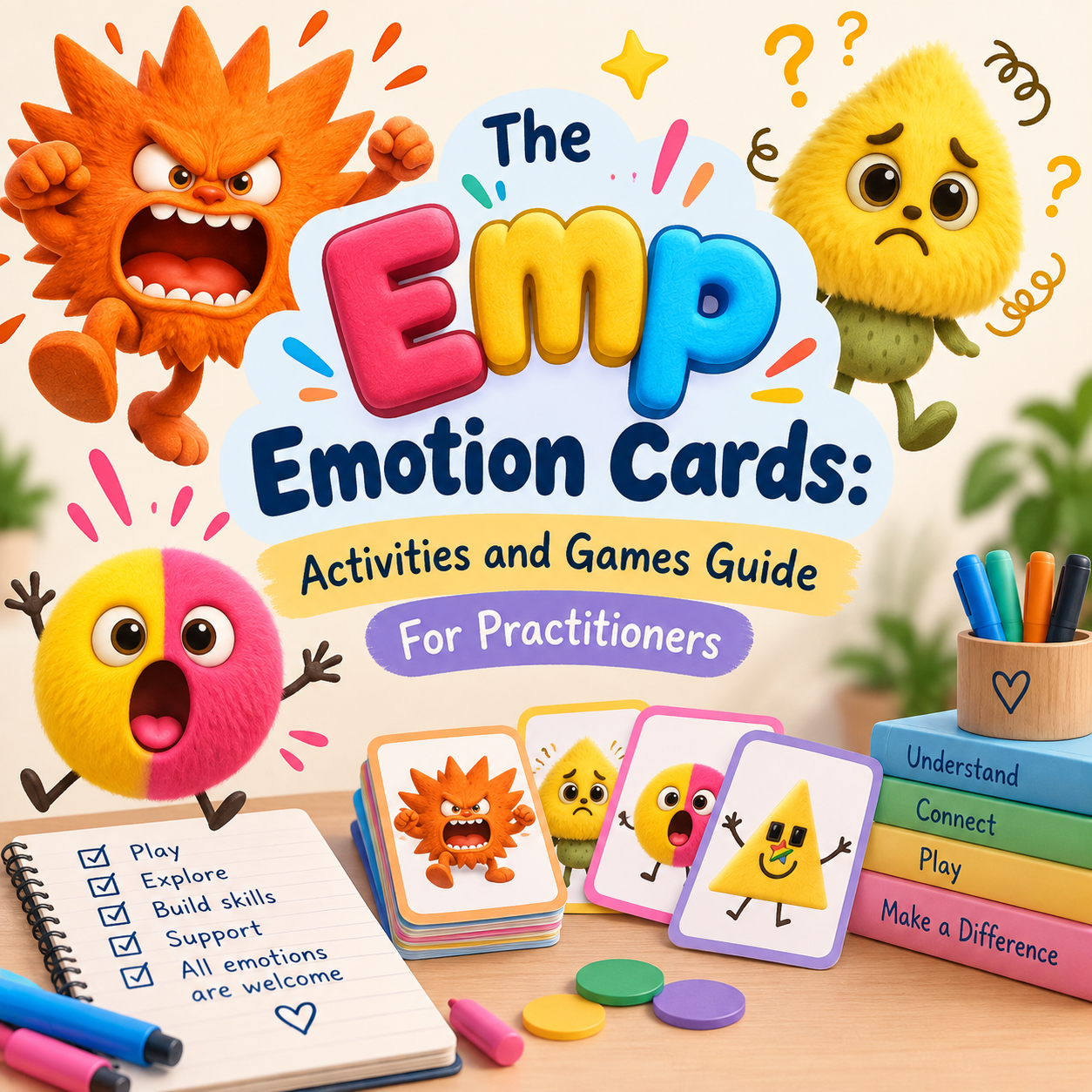
The Emp Emotion Cards: Activities and Games For Practitioners.
Whether you're running a whole-class check-in, an ELSA session or a therapy hour, The Emps give children a friendly, shared language for their inner world. The activities below span daily emotional-literacy practice, targeted work around specific feelings, and structured ideas for friendships, learning and whole-school approaches. Everything is psychologically informed, low-prep and ready to fit your existing lessons/sessions.
General Strategies
-
Morning Emp: as children arrive, they place a name peg or counter beside the Emp "visiting" them today. Glance at the board to spot who needs an early conversation.
Three-Emp check-in: ask each child to pick the Emp they arrived with, the Emp they'd like to visit by the end of the day, and the Emp that helps them learn.
Traffic-light Emps: sort the set into green (ready), amber (getting tricky), red (really hard). Children point to the row that matches them. Useful before tests, transitions or assemblies.
Weather report: "What's the Emp weather inside you today?" Sunny, cloudy, stormy — children pick one or two Emps to describe their inner forecast.
End-of-day exit ticket: as children leave, they touch the Emp that visited most today. Quick way to notice patterns across a week.
Friday review: lay out the week — "Which Emp came on Monday? Which one popped in at break time?" Builds reflection and memory of feelings.
-
Body map: draw a gingerbread outline. Pick an Emp and shade where it's felt in the body (tight chest, hot face, jelly legs). Compare across the group (same Emp, different bodies).
Voice the Emp: "What might this Emp say out loud?" Children write or say one sentence in the Emp's voice. Useful for noticing the inner critic.
Story characters: while reading a class book, pause and ask "Which Emp is visiting [character] right now? How can you tell?"
Volume dial: for each Emp, where on a 1–10 dial is it today? Helps children notice intensity, not just presence.
-
Iceberg: draw an iceberg. Place the loud Emp above the waterline (e.g., Flaregrump). Underneath, place the quieter Emps that may be hiding (sadness, worry, feeling left out). Discuss what helps the underneath Emp first.
Detective game: "This Emp came knocking, who else is hiding behind them?" Children turn over a second card to investigate. Talk about clues from the body and the situation.
Two-card stories: deal each child two random Emps and ask them to invent a short story where both Emps visited.
Emp duos wall: build a class display of common pairings the children notice e.g., Anger and sadness, excitement and anxiety. . Add new pairs as they spot them.
Calm the underneath one first: when an Emp is loud, ask "Who else is here?" and try a Disarming Step from the quieter Emp's card. Often the loud one settles when the underneath one is heard.
-
How do you feel about…? lay the cards out and ask the child to choose Emps for: school, lunchtimes, maths, playtime, the new topic, the supply teacher, the school trip, the changing room. One at a time, no pressure to explain.
Friendship map: name three or four friends. For each, choose the Emp(s) that visit when you're with them. Useful for spotting friendships that are draining versus nourishing.
Transition Emps: pick an Emp for: arriving at school, the start of a lesson, end of the day, going home, coming back after the weekend. Patterns reveal where support is needed.
New-experience prep: before a trip, test, performance or new class — "Which Emps do you think will visit? Which ones would you like to invite? Which Disarming Step will you pack?"
Three-Emp self-portrait: "Choose three Emps that describe you most days." A gentle, child-led version of "tell me about yourself."
Pre and post lesson: "Which Emp came to maths today? Which one would you like to visit next time?" Brilliant for tracking subject-specific feelings.
-
Match the moment: read a short scenario ("Your friend sat next to someone else at lunch") and ask which Emp(s) might visit, who else might be underneath, and which Disarming Step could help.
"What if…" basket: children pull a what-if card and choose Emps to respond. Use real situations from the class context — break-time disagreements, getting told off, losing a game.
Sort by intensity: sort situations from "a-bit-tricky" to "really-big" and notice which Emps tend to live at each level. Helpful for proportionality work.
Role-play with cards: two children act out a scenario; a third holds up the Emp they think is visiting each character. Switch roles.
Solution cards: after matching an Emp, child writes their own Disarming Step on a blank card. Builds ownership and personalised strategies.
-
Strategy of the week: the whole class learns one Disarming Step. Practise it daily — before lining up, after the register, end of assembly.
Strategy menu: a child chooses any back-of-card strategy and tries it for two minutes. Reflect: did it help? Where did you feel the change?
Strategy partners: pairs teach each other their favourite Disarming Step. Teaching it embeds it.
Body anchors: link each strategy to a body part or movement so children can find it without the card (e.g., fists for Gentle Grip, balloon hands for Burst Breaker).
Strategy passport: each child collects strategies they've tried, with a tick if it helped. Over time they build a personal toolkit.
-
Charades: draw an Emp and act it out — face, body, sound effects allowed. Class guesses.
Guess Who? one child secretly picks an Emp; others ask up to ten yes/no questions to find it ("Does it visit when something is unfair?").
Story dice: shuffle the deck, draw three Emps, build a story that includes all three.
Beat the clock: name as many Emps as you can in 30 seconds while a partner holds them up.
Emp bingo: children mark off an Emp on their bingo board when it's named in a story or video clip.
Card walk: spread the cards face-up around the room. Music plays; when it stops, children stand by an Emp and share a tiny memory of when it visited.
-
Memory pairs: all cards face down; turn two over, keep the pair if they match. Great for reinforcing names.
Snap: classic snap with Emp pairs.
Go Fish: "Do you have Snixx?" Builds Emp vocabulary fast.
Top Trumps style: rank Emps on cards children have annotated themselves (intensity, how often they visit, how easy to settle).
Empathy guess: Player A secretly picks an Emp from deck 1. Others ask situation questions ("Would this Emp visit if you lost a game?") and try to find the matching card in deck 2.
Tailored Ideas for Friendships
-
Friend-by-friend Emps: name a friend; pick the Emps that visit when you're with them. Repeat across several friends.
My-best-self Emps: "Which Emps does my friend bring out in me?" Encourages awareness of healthy versus unhealthy dynamics.
Their-Emp empathy: "Which Emp do you think visits your friend when X happens?" Builds perspective-taking.
-
Two-card mediation: after a fall-out, each child picks the Emp that visited them. They show, not tell. Usually defuses the room within a minute.
Repair script: "My Emp was ____, I think your Emp was ____. What could help next time?" — far gentler and more meaningful than apologies.
Underneath together: look for the Emps under the angry ones in both children at once. Often you find similar feelings — a powerful moment.
-
Lunchtime cards: ELSA/ wellbeing station with cards at a known table. Children can drop in and pick an Emp without having to talk. Very powerful for those on the edges.
Group-norm setting: use cards to agree class rules — "Which Emps do we want to see more of? Which ones do we want to help leave quickly?"
-
Story-stop empathy: read-aloud a story, pause and ask each child to choose an Emp they think a character is feeling. Compare answers: there's is rarely one right one.
Walk-in-their-shoes: Children choose an Emp then swap Emp choices with a partner: "You felt this Emp at break? Tell me more."
Tailored Ideas For Learning
-
Pre-lesson Emp: as books come out, children pick the Emp arriving with them to today's lesson. Quick read on the room.
Mid-task pause: at the trickiest point of the lesson, pause and ask "Which Emp is here right now?" Normalises stuck-feelings.
Post-lesson reflection: "Which Emp was here at the start? Which one is here now?" Shows children that feelings move.
-
Stuck-Emp protocol: an agreed Emp (e.g., one for confusion or frustration) that children can place on the corner of their desk. Signals "please come" without putting a hand up.
Disarming Step at the desk: the back-of-card strategy is the first thing tried when stuck — before asking for help. Often it's enough.
-
Brave Emp partner: before a hard task, choose an Emp to bring with you as a companion.
What would this Emp say? for harsh inner critic moments, ask "What would the kindest Emp say to you right now?" Reframes self-talk gently.
-
Mistake Emp: agree which Emp visits when you make a mistake. Normalising it removes shame.
Two-card mistake reflection: Emp at the moment of the mistake; Emp once you'd worked through it. Shows growth.