
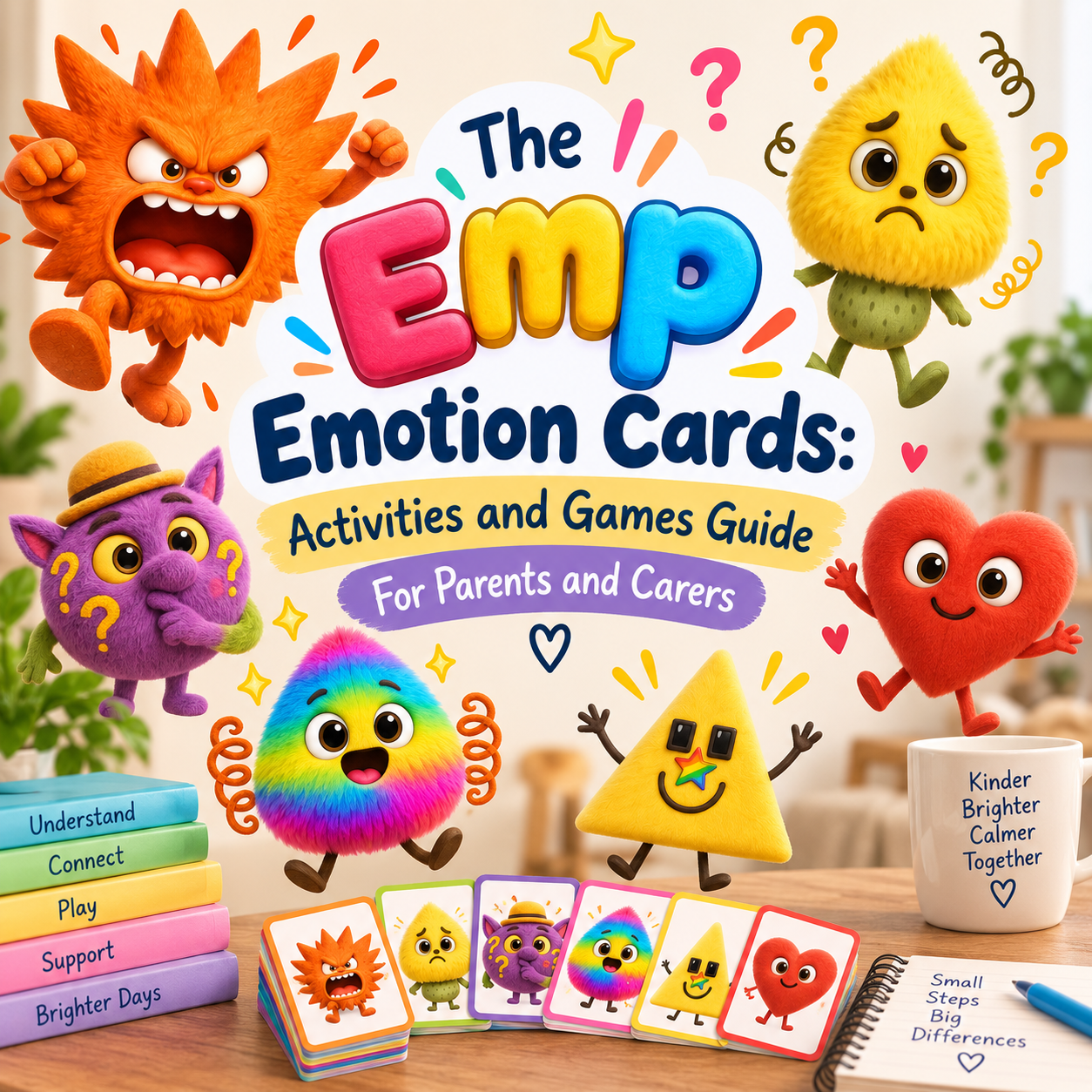
The Emp Emotion Cards: Activities and Games For Parents.
Parenting is emotional work, and children learn to handle emotions by watching how the grown-ups around them handle theirs.
The activities below are small, do-able ideas for using the Emps at home: at breakfast, out and about, at bedtime, or in the middle of a wobble. There's no right way to do it and nothing to get through. Choose one, try it for a week, see what shifts. That's plenty.
-
Morning Emp: before school, child picks the Emp that's with them. No fixing — just noticing. "Thanks for telling me. Bumpa is welcome to come too."
Bedtime three: as part of wind-down, choose one Emp from today's best moment, one from today's hardest moment, and one you'd like to visit tomorrow.
Car/walk talks: keep a small set in the car. "Did any Emps visit at school today?" Side-by-side conversations are easier than face-to-face.
Family Emp board: everyone in the household places a peg by their visiting Emp on the fridge. Parents do it too — children love seeing grown-ups have feelings.
-
Before the wobble: use cards before known triggers (leaving the park, screen-time ending, dentist) to predict which Emp may visit and choose a Disarming Step in advance.
After the storm: once everyone is calm, look at the cards together. "Which Emp came? Who else was underneath? What helped them go?" Repair, not interrogation.
Goodbye Emp: for separation moments (e.g. drop-off, sleepovers) name the Emp and pack one Disarming Step in a pocket.
Sibling sharing: after a fall-out, each child picks the Emp that visited them. Hearing each other's Emp lowers the temperature faster than "who started it."
-
Iceberg chats: "That looked like Flaregurmp, was he protecting anyone? Helps children find the hurt, shame or anxiety under the anger.
Two-Emp tuck-in: at bedtime, choose two Emps that visited today and talk about how they got along.
Parent goes first: "Today I had Fraggle visit before my meeting, and Zestle came too." Modelling is the most powerful teacher.
-
Memory pairs (two sets): good for younger children — also great for naming Emps repeatedly without it feeling like teaching.
Storytelling rounds: draw three Emps; each family member adds a sentence to a shared story using their Emp.
Emp charades: act it out at the dinner table. No sound.
Top three this week: on a Sunday, each person picks the three Emps that visited most. Notice patterns gently — "Fraggle’s been around a lot this week, hasn't it?"
-
Permission phrases: "It's OK that Snixx visited — Snixx is welcome here. But throwing things is not" Removes shame from emotions and boundaries the behaviours.
Connection before correction: before discussing behaviour, name the Emp first. The conversation goes much further when the emotion has been seen.
Coping kit: with your child, build a small box with objects that match Disarming Steps — a pinwheel for Burst Breaker, a stress ball for Gentle Grip, a soft toy for comfort. The cards then become real.
Parent's own Emp: let children see you use the cards on yourself. Shows that emotional regulation is a lifelong practice, not a child's job.